Tuesday, January 28, 2014

Wildlife Exhibit at the Sunriver Library

PAINTINGS AND SCULPTURES   

by artists Vivian Olsen and Joren Traveller


The artists - Joren and Vivian, Secretary and President of the High Desert Art League

Vivian hanging "Raven Outside the Box"
 one of her 12 paintings - Oils and Pastels

Helen Brown, HDAL Treasurer and Library art curator,
and Joren hang one of her many Sculptures,
both bronzes and ceramics

The exhibit will be on display from Jan. 25 to March 29, 2014

Wednesday, January 22, 2014

WILDLIFE ART - Paintings and Sculptures

Two HDAL Members Exhibit at Sunriver Library


Ravens, owls, and antelope . . . and maybe an occasional horse, too . . . are the subjects depicted by artists Vivian Olsen and Joren Traveller. Both artists are members of the High Desert Art League. Their exhibit opened at the Sunriver Area Library January 25th and will stay up until March 29th.

Vivian paints from her studio in Eagle Crest, Oregon and exhibits her artwork regularly throughout the Northwest in group shows with the High Desert Art League or in solo exhibits. Her artwork may be viewed on her websites:   www.vivianolsen.com and www.highdesertartleague.com. She is President of the High Desert Art League, and a member of Oil Painters of America, and American Women Artists.

Joren Traveller is a sculptor and painter. Sculpting in bronze has been her favorite medium but she has expanded her interest to include hand built ceramic sculpture and also does animal portraits by commission. Her artwork may be viewed on her websites: www.jorentraveller.com and www.highdesertartleague.com. She is a member of the Red Chair Gallery in Bend and also a member and Secretary of the High Desert Art League. 


Wednesday, January 15, 2014

Through Redmond to Oregon Art Beat

Artist Cameron Kaseberg Makes Oregon Art Beat

Redmond artist Cameron Kaseberg has been pushing, playing with and refining the art of solvent transfer since his college days. It has been an exploration of the process brought to prominence in the 1950’s by Robert Rauschenberg. For Oregon Public Broadcasting it was a unique process and story that will air January 30th on OPB’s Oregon Art Beat.

For Cameron, the Oregon Art Beat story began at the very first Art in the High Desert festival (Bend’s nationally ranked fine art festival) and the first art festival he had ever done.  There, Cameron met artists who had been featured on Oregon Art Beat. “I was in awe,” he says. “It is a rare Oregon artist whom does not dream of being featured on Oregon Art Beat, and at that festival it became mine, too” he adds. Oregon Art Beat is an Emmy award-winning weekly television series produced by OPB. It profiles artists of all genres, and suggests upcoming events in the Oregon community.

From left to right: Ted Cutler (Audio tech, Oregon Art Beat),
Tom Shrider (Videographer/Editor, Oregon Art Beat),
Katrina Sarson (Oregon Art Beat Co-Host/Producer),
Cameron Kaseberg (artist).
The reality of Cameron’s dream began unfolding in May of 2013 with an unexpected call from Katrina Sarson, a producer for Oregon Art Beat.  Katrina had seen Cameron’s work on the Art in the High Desert website and was intrigued by the process. Within two weeks Katrina and the Oregon Art Beat crew arrived in Redmond to begin filming Cameron’s story. “I was a nervous wreck,” he said, “but the moment they walked in the door all of my trepidation vanished. They were amazing.” He said. Filming took place in Cameron’s home where he works, with a trip to Smith Rock State Park where he sometimes hikes and photographs material for his art.  “In one day we shot elements of every step in the process of making one of my pieces,” Cameron explained. “From photographing at Smith Rock all the way through editing images and putting the final piece together. The last bits of filming were shot as I was setting up for Art in the High Desert to sell my work” he added. 


The Oregon Art Beat episode will air Thursday, January 30th at 8:00 p.m. on OPB. For more information on Cameron’s work visit www.kaseberg.com or through the High Desert Art League website. To learn more about Oregon Art Beat, visit http://www.opb.org/programs/artbeat.

Wednesday, December 11, 2013

Plein air painting is a discipline that requires attention and presence, that is different than working from a flattened and static photograph, in that you are translating the information to a canvas as the light changes.

The magic occurs somewhere between the subject and the applied medium.  We are not attempting to make a photograph, but a poetic interpretation that has moved the artist in their deep observation of our world.

David Kinker would like to invite painters to experience the beauty of the Rogue River on a painting trip, lodge to lodge, and painting from nature.
Trips are scheduled for June 1, 2014 and August 30, 2014.
Contact ROWadventures.com 


Sunday, November 17, 2013

Helen Brown • Watercolor Batik • Finishing Up


So now the painting is finished, (see two previous posts) but it is completely covered with paraffin. So the next step is to iron out the wax so that all that is left is a watercolor painting on rice paper.


I take yesterday’s newspaper, slip the painting into the middle and use my ski waxing iron to heat up the painting until I can see wax pouring out and getting absorbed into the newsprint. I repeat this process at least 4 times to make sure all the wax is gone. The photo below shows white newsprint. You don't really need to use unprinted newsprint. The regular newspaper is fine.


Once I’m sure all the wax is removed (i.e. no more wax appears on the absorbent paper while pressing with a hot iron), I adhere the batik to a piece of 300 lb. watercolor paper. I don’t always do this step, but if I want it to lie very flat in the frame, I do. Here’s how: I use a credit card and spread Matte Medium over the watercolor paper. When I’m sure it is evenly spread, I place the painting onto it and brayer it down with a roller OVER a piece of wax paper. Then I carefully remove the wax paper and let it dry flat.


Be sure to sign your work! I usually do that before using the matte medium.


At the Tumalo Art Co. after Thanksgiving, you will see at least 8 of these little batik paintings. Stop by!


The Tumalo Art Co. artists have also made amazing little works of art for ornaments. David Kinker, another High Desert Art League member will have small works there, too. 

I love the holidays!  Hope you do, too!


This blog is produced by the High Desert Art League. We are a group of artists who show together in and around Central Oregon. We are currently showing our work at St. Charles Medical Center on the cafeteria level, and at Central Oregon Community College in the Rotunda Gallery of the campus library. Our Broken Top Clubhouse show comes down Wednesday, November 20.


Friday, November 8, 2013

Helen Brown • Watercolor Batik • Getting on with it!


In my last blogpost (Nov. 3rd), I showed the supplies and set up needed for batiking with watercolor. Now I’ll show you how I proceed with the actual painting. I’m working on some small works for the Tumalo Art Company’s holiday show. This is a little painting of a Barrows Goldeneye. It’s only about 4” x 6”, but the process is the same for large pieces.


First I draw on the smooth side of the rice paper with a black ballpoint pen. Just make sure the ink in the pen is not water soluble or it will smudge. Then I paint a very light wash of different colors, not being concerned about staying with my lines at all. This photo shows the next step after my first light wash has dried. I paint with molten wax onto the areas I want to remain almost white. Here I waxed the mark on his face, some of his body and some horizontal lines in the water. Notice the black construction paper I keep handy to slip under the wax paper so I can see where I'm painting the wax.


The wax hardens almost instantly so I don’t have to wait to continue to the next step: PAINTING! Because I have protected areas with the wax, I do not have to paint very carefully around the light spots. You can see in the photo below where the blue paint is being resisted by the wax. 


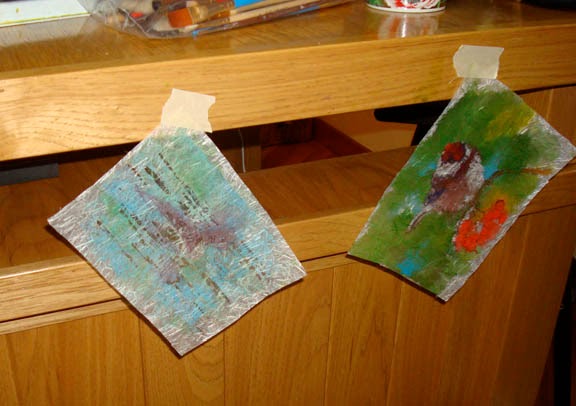
At this point in each layer, you must allow the paper to dry completely. I usually tape it from my painting table as in the photo below.


Continue waxing each consecutive area of light, and then painting in the darks until you are satisfied that the painting is finished. Allow to dry one last time before covering the entire surface with the wax, using a larger brush. REMEMBER that the wax will ruin your paintbrushes, so use inexpensive ones.


In my next post, I’ll show how to get rid of all the wax, and how to mount your painting for framing.

Where can you see examples of my work using this method?
• Tumalo Art Company in Bend's Old Mill District
• Broken Top Clubhouse has an exhibit of the High Desert Art League until November 20.
• COCC's Rotunda Gallery in the library has a High Desert Art League show until December 6.


Sunday, November 3, 2013

Helen Brown • Watercolor Batik - preparing to paint


This month, I have been assigned to blog on the High Desert Art League blogspot site. I thought I’d share about my painting process for watercolor batiking. Starting with supplies:

• Here’s the paper I use:
It is rice paper. Any kind of rice paper will work, but I like Ginwashi Rice paper. It has little stick-like flecks in it. The paper is amazingly strong for how fragile it looks! As you can see by the photo, you can see through it.

• I buy regular old paraffin at the grocery store and melt it in my little crock pot (see photo). I bought this crockpot at Goodwill for $5. I use regular wax paper and IMPORTANT: I only use inexpensive brushes with the wax. Between the heat and the wax, the brush is ruined in a couple of paintings.


• Then I set up my paper like this photo below. I tape a piece of white paper to my board (unless the board is already white). On top of that, I tape a piece of wax paper. I then work with my rice paper on top of that. If I can’t see where I’ve put the wax, I slip a piece of black construction paper under the wax paper because the wax will show up better over the black.


Now I am ready to draw on the rice paper and begin my painting!

Watch this site for my next steps...

To see some of my finished work, go to the Tumalo Art Company in Bend, Oregon's Old Mill District, three stores down from REI.  I am one of the featured artists there during the month of November (2013).